
The Hybrid Labor Model: What Actually Works in the Field
Updated and expanded from 'Tips for Success Leveraging a Contingent Workforce' (2020)
Between continued talent shortage pressures, the evolution of what we're requiring of field technicians, and relentless customer pressure to deliver more faster, more and more service organizations are turning to contingent workers to meet their service demands. And they should be.
I've spent more than 25 years building and running distributed field operations — using in-house only models, outsourced-only models, and hybrid labor models. I've seen what works and what doesn't. I've also lived the mistakes firsthand, which is where the real learning happens.
The hybrid labor model — blending W2 employees with 1099 independent contractors — is not a new concept. But most organizations that attempt it either underestimate the operational complexity required to run it well or treat it as a binary choice: all in or all out. Neither approach serves you well.
It's Not a Binary Choice
The most important thing I can tell you about a contingent workforce is this: stop thinking about it as an all-or-nothing decision.
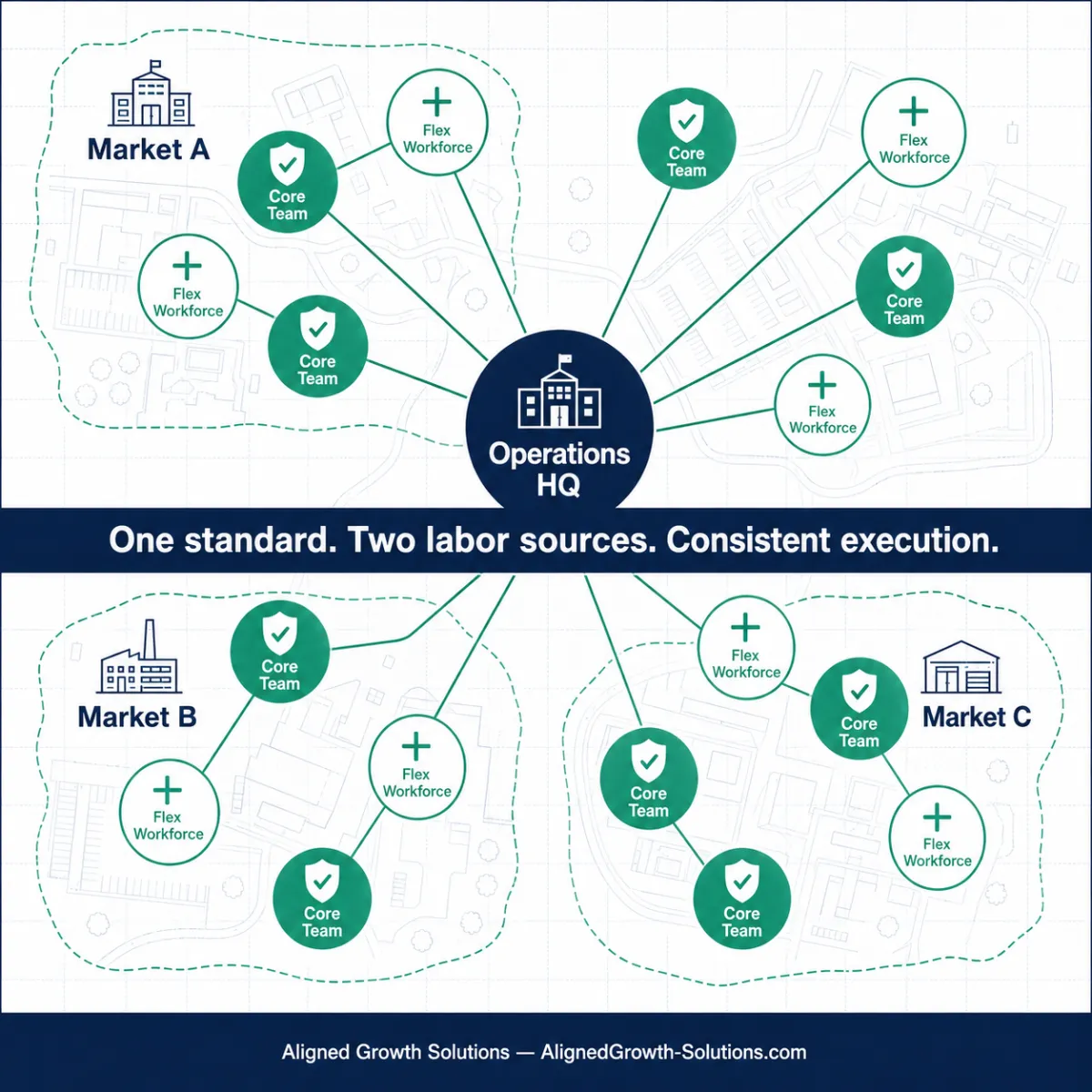
If you take it down to its most basic components, a hybrid labor model gives you three things: flexibility, scalability, and cost control — without sacrificing service quality, if you manage it right. The key is understanding that the right mix isn't universal. It varies by company, by market, and even by function within the same organization.
Some of your markets may have low technician utilization — in those cases, you rarely need contractors because you have the bandwidth. Other markets run at high utilization and will use a much higher proportion of contingent labor. Even within the same division, the usage levels will differ. The model has to reflect that reality.
Start with lower-complexity tasks. If I need three technicians on a job, I might send one tenured W2 tech and two contractors to support. This approach is low risk — it lets you build confidence in your 1099 workforce while keeping your experienced people in an oversight role. The combinations are nearly limitless. The goal is to find what works for your organization and grow it from there.
"The hybrid labor model isn't about replacing your W2 workforce. It's about building a flexible operational capability that lets you scale into new markets, manage peak demand, and control costs — without sacrificing execution quality."
The Operational Infrastructure You Actually Need
Here's where most organizations fail: they adopt the hybrid labor model without building the operational infrastructure to support it. They get the platform, they access the labor pool, and then they discover that running a hybrid workforce is operationally more complex than running a pure W2 model — not less.
The discipline required to manage contingent workers well is the same discipline required to manage any distributed field operation well. It just gets exposed faster when you're dealing with workers who have no historical relationship with your company, your customers, or your standards.
What you need before you scale a hybrid model:
- Real-time visibility into work being performed on-site — not end-of-day reporting, but active visibility
- Detailed, clear runbooks and work instructions — what has to happen on-site, step by step, with no assumptions
- A disciplined quality audit process — your W2 team checking deliverables, not just trusting completion status
- A lifeline for contractors in the field — someone they can reach when they encounter something outside the scope of their instructions
- A vetting process that actually works — not just credential verification, but behavioral assessment and performance tracking
Setting Contractors Up to Succeed
One of the most important things I've learned about managing a contingent workforce is understanding what motivates a 1099 worker differently than a W2 employee. A contractor's next job depends on how well they do this job. If you make it hard for them to succeed, they'll go find someone who makes it easier. If you set clear expectations, give them the tools and support they need, and treat them professionally, you build a reliable labor cloud that functions like an extension of your own team.
Whenever possible, I have a new 1099 contractor go alongside one of my tenured W2 techs for their first few jobs. They see firsthand what our expectations look like in practice. It sets them up for success, keeps them engaged, and builds the mutual confidence that makes the relationship work long-term.
The vetting process matters too. I use third-party platforms that give me access to contractor profiles, skill histories, performance ratings from other companies, and the tools to track performance over time. The first step is no different from screening a resume — you look at their work history and verify they have the right skills and certifications. The second step is having your field service management team interview the contractor the same way they would interview a potential W2 hire. Regional managers make the call. That ownership matters.
The Market Expansion Opportunity Most Companies Miss
Here's the strategic play that many organizations overlook entirely: the hybrid labor model isn't just a cost management tool. It's a market expansion capability.
When your sales team wins a customer in a market where you don't have a critical mass of W2 technicians, the traditional answer is to pass on the business or take the risk of overstaffing for a market you haven't proven yet. The hybrid model gives you a third option: get into the market using your contingent labor pool, prove the volume, and then start placing W2 employees once you've built the critical mass to justify it.
Being able to enter new markets at a lower cost point and a lower initial risk level is one of the most underutilized advantages of the hybrid model. It lets you say yes to business you would have had to turn down before.
What I've Learned After 25 Years
The organizations that run hybrid labor models successfully share a few common traits. They're disciplined about standards — they don't assume contractors will figure it out. They're intentional about oversight — they use their W2 workforce as a quality layer, not just a separate labor pool. They're honest about the operational complexity — they invest in the management infrastructure before they scale the model. And they're patient — they start with lower-complexity tasks, build confidence in both directions, and grow the model deliberately.
The organizations that fail with a hybrid model almost always make the same mistake: they adopt the labor flexibility without building the operational discipline to sustain it. The platform gives them access to the workforce. The execution falls apart because the underlying system isn't built to support it.
To start: quit thinking of all the ways it won't work. Find one or two ways it might work, try it, and see how it grows from there. The flexibility, scalability, and cost control are real. So is the operational work required to capture them.
One Critical Caveat: The Regulatory Environment Has Changed
This article focuses on the operational model — how to structure, run, and scale a hybrid labor model effectively. But I'd be doing you a disservice if I didn't acknowledge that the legal and compliance landscape around independent contractor classification has shifted significantly since I first wrote about this topic in 2020.
Co-employment liability, state-specific worker classification rules (including California AB5 and similar legislation in other states), IRS classification standards, and platform liability exposure are real and consequential risks that have to be part of your planning — not an afterthought. Getting the operational model right and the compliance model wrong can create liability faster than the hybrid model creates flexibility.
The good news: the compliance infrastructure and the operational infrastructure reinforce each other when both are built correctly. Platforms like Openforce exist specifically to manage the contractor compliance layer — onboarding, classification, insurance, and payment — so that your operational team can focus on execution rather than liability management.
I've addressed the regulatory and compliance landscape in detail in a separate white paper — covering the key regulations by state, co-employment risk factors, and the compliance infrastructure you need alongside the operational infrastructure. If you're building or scaling a hybrid labor model, read both before you scale.
Charles Hughes is the founder of Aligned Growth Solutions and creator of the CULTIVATE Operating System™. He was recognized with the Field Service Best Service & Support Strategy Team Implementation award in 2017 for hybrid labor model deployment at enterprise scale. He works with field service, MSP, and infrastructure companies as a fractional Operational Execution Architect.
Aligned Growth Solutions · AlignedGrowth-Solutions.com · (440) 915-2361